SHARE

How Calgary Contractors Can Handle Repetitive Customer Emails Without Writing Every Reply From Scratch
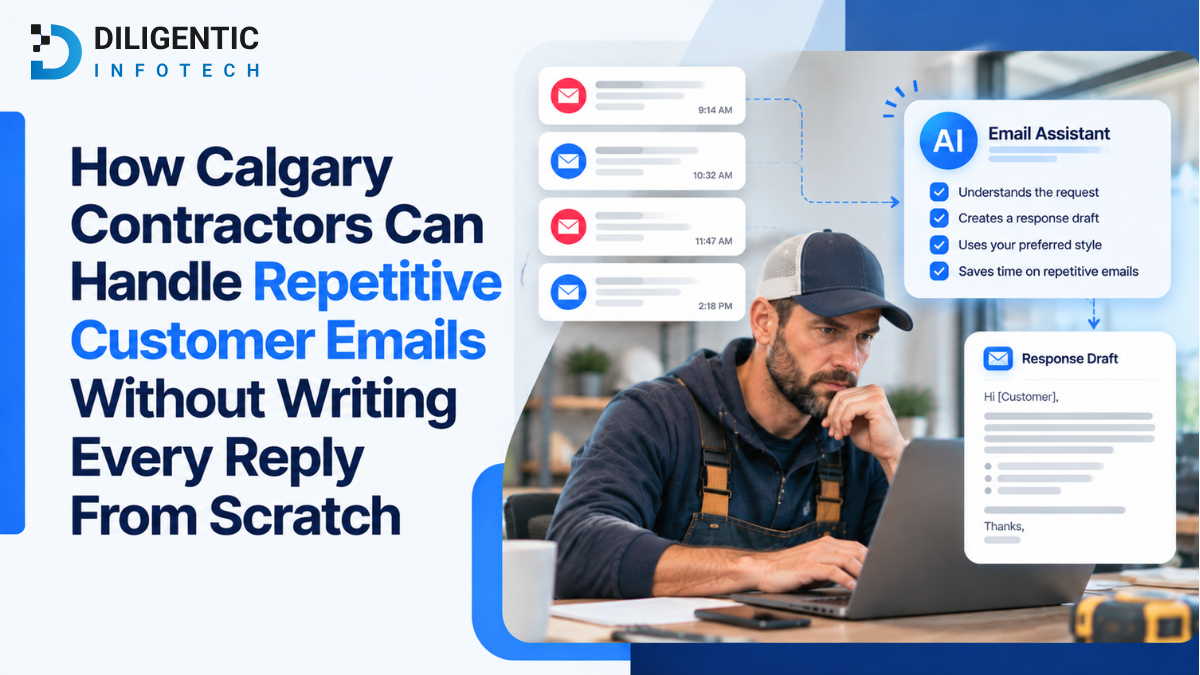
Repetitive customer emails for contractors often create the same office work under different subject lines. A question may look new because the wording changes, while the appropriate reply follows an established business rule. If employees repeatedly build those replies from scratch, start by identifying the pattern before deciding whether templates or AI-assisted drafts will help.
Calgary HVAC, plumbing, electrical, and roofing offices can use this guide to turn recurring email types into a practical reply library, then assess whether an AI drafting workflow is appropriate.
Table of Contents
Find the repeated reply patterns before choosing a tool
Do not start by reviewing every message in the inbox. Take a manageable sample of recent sent emails and group them by the work needed to answer them.
For each group, record four things:
| Record | Question to answer |
|---|---|
| Customer’s purpose | What is the customer trying to confirm, request, or understand? |
| Business rule | What approved process determines the response? |
| Information needed | Which current details must be checked before replying? |
| Escalation point | When should an employee stop and ask another person? |
For example, a routine document request may be repeatable if the correct document can be identified and sent under an approved process. A pricing exception is not a routine drafting task because it requires a commercial decision. The distinction matters more than the email’s wording.
The result is a reply library: a short list of recurring situations, the information required for each, approved wording or content blocks, and the conditions that require human judgment. This is useful even if the business never adopts AI.
Decide whether a template, reply library, or assisted draft fits
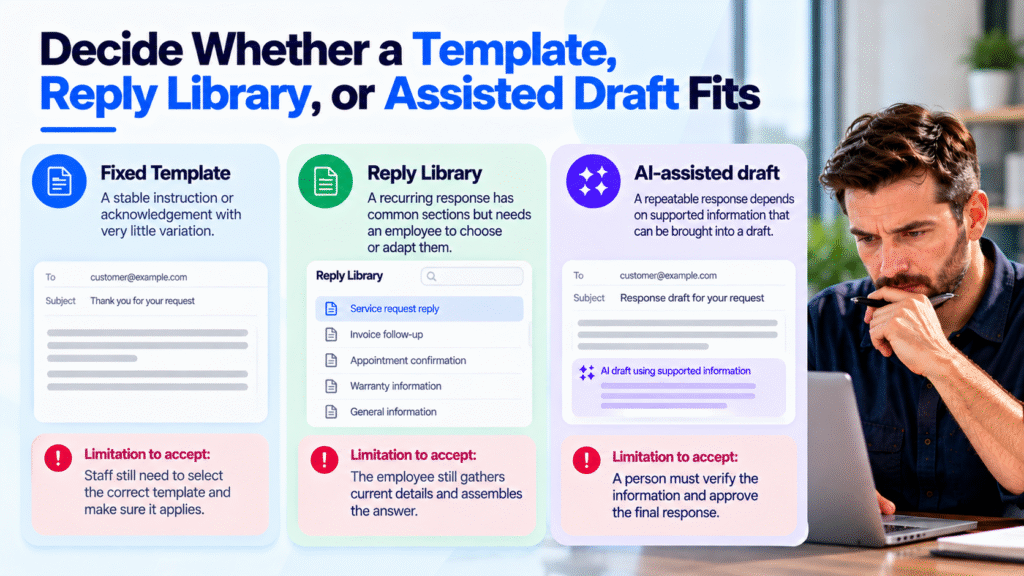
Not every repeated email needs the same level of support. Choose based on how much of the response changes from customer to customer.
| Option | Best fit | Limitation to accept |
|---|---|---|
| Fixed template | A stable instruction or acknowledgement with very little variation | Staff still need to select the correct template and make sure it applies |
| Reply library | A recurring response has common sections but needs an employee to choose or adapt them | The employee still gathers current details and assembles the answer |
| AI-assisted draft | A repeatable response depends on supported information that can be brought into a draft | A person must verify the information and approve the final response |
A reply library is often the sensible middle step. It helps employees use consistent language without pretending that every customer situation is identical. It also exposes whether the business has clear response rules before any automated drafting is considered.
Discuss your repetitive email workflow with Diligentic if your team has identified recurring replies but still spends time rebuilding them. The link starts a qualifying conversation; if there is a fit, Diligentic can arrange a workflow audit.
Define the inputs before expecting an accurate draft
An assisted draft is only as reliable as the information and rules available to it. Before assessing an AI email assistant, identify what must be true for each reply category.
For a routine document request, the workflow may need to identify the customer, find the correct available document, and know whether the request can be completed without approval. For service-preparation guidance, it may need approved instructions for the relevant work type. For a complaint, it may need to stop rather than draft an answer that creates a commitment.
Write the conditions in plain language. For example:
- Use the standard preparation guidance only when the job type is confirmed.
- Ask for a missing identifier when the customer record cannot be matched.
- Route any request involving a price change, warranty decision, or dispute to a named employee.
- Do not state that a document, service, or decision has been approved unless the available record supports it.
These rules create a useful test for any provider. A polished sentence is not enough. The draft must handle missing or conflicting information in the way your business expects.
Where AI-assisted drafting may fit
Diligentic’s AI Customer Support Email Assistant reads supported incoming emails, checks available order or account details, and prepares editable response drafts. Employees review, edit, and send the final response.
That approach may suit a reply category when the business has repeatable guidance and supported information that can help prepare the draft. It does not turn unclear business rules into a reliable process.
Email drafting also differs from request management. A drafting workflow helps prepare a response. Request management shows who owns a message, which work remains open, and whether follow-up is complete. A contractor who needs better ownership or escalation may need process changes or connected tools in addition to drafting support.
NIST’s Generative AI Profile identifies confidently presented false information, or confabulation, as a generative-AI risk. For customer communication, that means the reviewer must treat a draft as proposed wording, not as proof that the facts are correct.
A worked example: routine document requests
Proposed workflow, not a client result: A contractor receives regular requests for copies of records that customers need for their files. The messages use different language, but the employee follows the same basic sequence: identify the customer, confirm which document is being requested, find the available record, and check whether it can be sent.
A reply library could contain a short acknowledgement, a request for any missing identifier, and approved wording for when the document is attached. It would also state when the request must be escalated, such as when the available record is unclear or the request concerns a disputed charge.
An AI-assisted draft could help prepare the routine response if it can use supported customer or account information. Before sending, the employee checks that the document belongs to the correct customer and that the message does not disclose information inappropriately.
The same approach can be used for other recurring categories. The category should be selected because its rules are clear, not because it happens to generate the highest email volume.
Keep decision-making and review with your team
The aim is to remove repeated preparation work, not to delegate business judgment to an email draft.
| Draft-support task | Employee decision or check |
|---|---|
| Prepare wording from approved material | Confirm the customer and current record are correct |
| Ask for a missing required detail | Decide whether an exception needs escalation |
| Organize routine information for review | Approve pricing, warranty, contract, or technical statements |
| Present a standard next step | Decide whether the response should be sent |
Set review rules for each category. A routine request may need one check. A response touching payment, service scope, safety, complaints, warranties, or contract terms may need a different owner or approval step.
Before sharing customer correspondence with a provider, request written information about access, retention, deletion, and model-training practices. The Office of the Privacy Commissioner of Canada’s generative AI principles provide useful questions about personal-information safeguards.
Run a narrow pilot instead of trying to change every reply
Choose one email category with clear rules, a modest number of recurring examples, and an available reviewer. Do not begin with the most complex or sensitive messages.
For the pilot, compare the current and proposed processes:
| Check | What to observe |
|---|---|
| Preparation effort | Does the draft reduce the time spent locating and assembling familiar wording? |
| Factual corrections | How often must reviewers correct customer, job, or record details? |
| Escalation behaviour | Does the workflow make uncertainty visible when a rule cannot be applied? |
| Review effort | Can an employee verify the draft without reconstructing the entire situation? |
| Customer-facing quality | Does the final reply remain clear, accurate, and appropriate? |
Define acceptable results before expanding to another category. If staff still need to perform all of the original preparation work before they can trust the draft, the records, rules, or selected category may need more work first.
Bring a reply library to a workflow review
Bring five to ten anonymized examples from one recurring category, the reply patterns your team already uses, and a note of the information employees check before responding. Include one example with missing information and one that should have been escalated.
This gives Diligentic a practical basis for discussing whether clearer templates, a reply library, an AI workflow assessment, or later system integration is appropriate. It also prevents a demonstration from being judged only on how polished one sample email sounds.
Build consistency before adding speed
Repetitive customer emails for contractors are a prompt to examine the response pattern behind the message. A good starting point is a reply library that states what the customer needs, which information is required, and when the reply must be escalated.
AI-assisted drafting is worth assessing when that foundation exists and employees are still spending time rebuilding approved explanations. The employee remains responsible for the final response, while the workflow can focus on preparing a useful first draft.
Book your free workflow audit to review your repeat email categories, reply rules, and the preparation work that may be suitable for improvement. The link starts a qualifying conversation; if there is a fit, Diligentic can arrange the audit.
Frequently asked questions
What are repetitive customer emails for contractors?
They are messages that may use different wording but require the same response process. A reply library groups these messages by the business rule and information needed to answer them.
When is a reply library more useful than a template?
A reply library is useful when an answer has repeatable parts but still requires an employee to choose approved wording, add current details, or follow an escalation rule.
Can an AI assistant prepare a draft from a reply library?
It may be assessed when the relevant incoming emails and supporting information are available through supported sources. Employees should still review, edit, and approve the final response.
Which customer emails should not be included in an initial pilot?
Avoid complex or sensitive messages at first, including complaints, disputes, contract questions, warranty decisions, technical advice, and unapproved pricing changes.
What should a contractor bring to an AI email workflow discussion?
Bring a small anonymized sample from one repeat category, the current approved response approach, the information employees consult, and examples that require escalation.
About the author
Ajay Kumar
Founder and Director
About the author
Ajay Kumar is the founder and director of Diligentic Infotech, a Calgary AI automation company. He has 9+ years of hands-on technical experience and now focuses on helping small and medium businesses connect their existing tools and cut down manual work through practical AI automation. He leads with a clear focus on real, working solutions over one-time demos.

Posted on 2 Dec 2025
AI Automation: The Most Impactful Use Cases Companies Can’t Ignore
AI Automation is not optional anymore. Companies that ignore it fall behind in speed, accuracy, and cost management. This guide breaks down the most practical, high-impact use cases of AI and automation with real examples, clear explanations, and honest trade-offs.

Posted on 30 Apr 2026
AI Automation Services for Modern Businesses: Proven Strategies to Improve Efficiency and Reduce Costs in 2026
AI Automation services help businesses improve efficiency and control costs by automating repetitive, data-driven tasks and speeding up processes. It enables teams to reduce manual effort, minimize errors, and focus on higher-value work. Depending on the use case, a significant portion of routine activities can be automated, leading to faster operations, better decision-making, and scalable growth.
Posted on 2 Sep 2026
How Storm Lead Surges Overwhelm Calgary Roofing Companies—and How AI Lead Automation Helps in 2026
A major hailstorm can send a sudden wave of roofing enquiries into a Calgary company within hours. The challenge is not only answering calls. It is capturing every lead, collecting the right information, identifying urgent cases, assigning the next step, and keeping records updated while the team is already busy.