SHARE

AI Tender Assistant for Contractors: What to Check Before Choosing a Provider
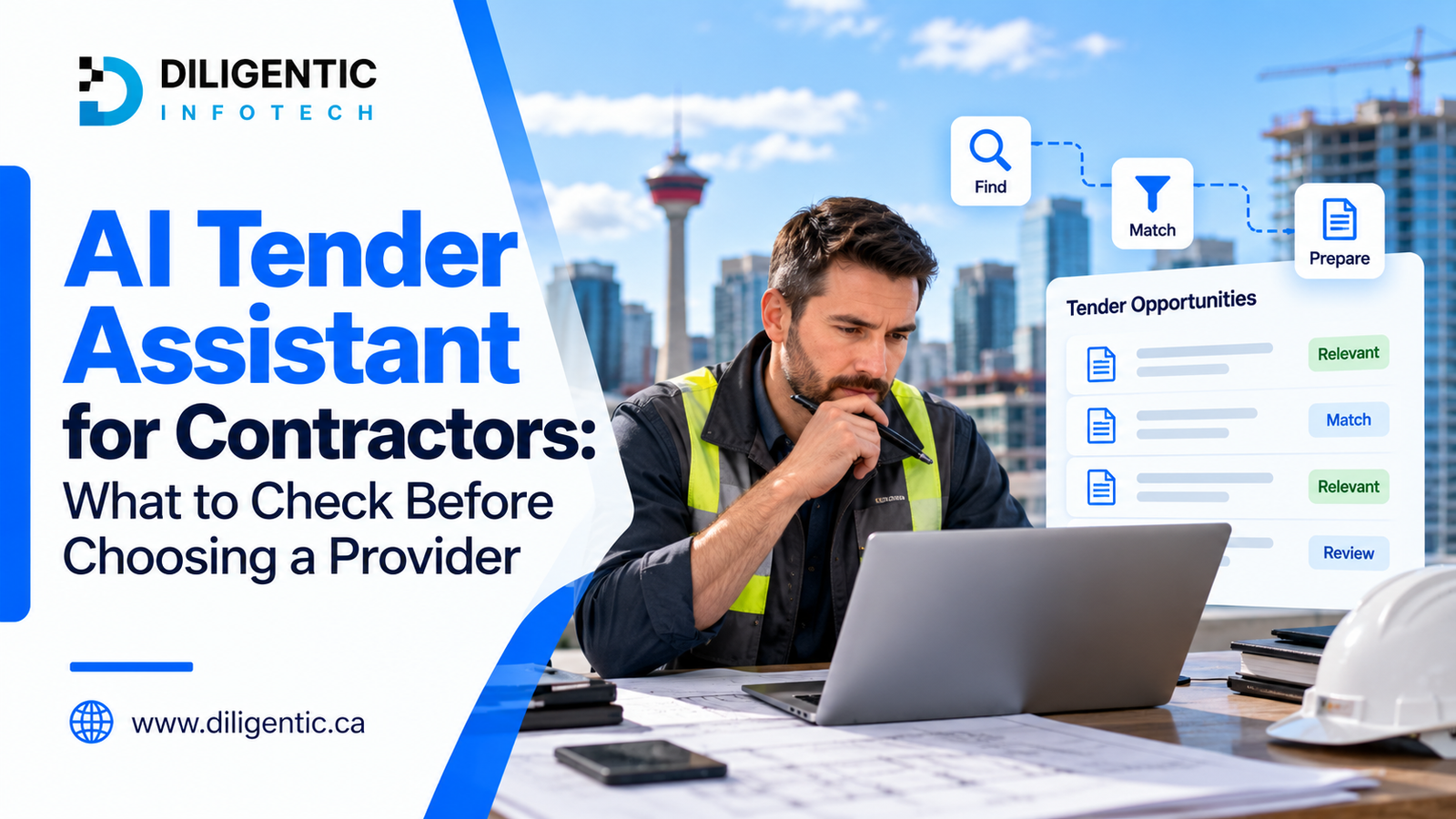
An AI tender assistant for contractors helps businesses find relevant tender opportunities, organize shortlists, and prepare proposal drafts for human review. Before choosing a provider, check which tender sources the assistant supports, how it matches opportunities to your business, and which decisions remain with your team.
For Calgary commercial HVAC, plumbing, electrical, and roofing contractors, the main question is practical: Which parts of your tender process should you automate, and what should your team continue to review manually?
The right solution depends on how often your business searches for opportunities, the sources you use, and the amount of repetitive work involved in preparing bids.
Table of Contents
When Does an AI Tender Assistant Make Sense for Contractors?
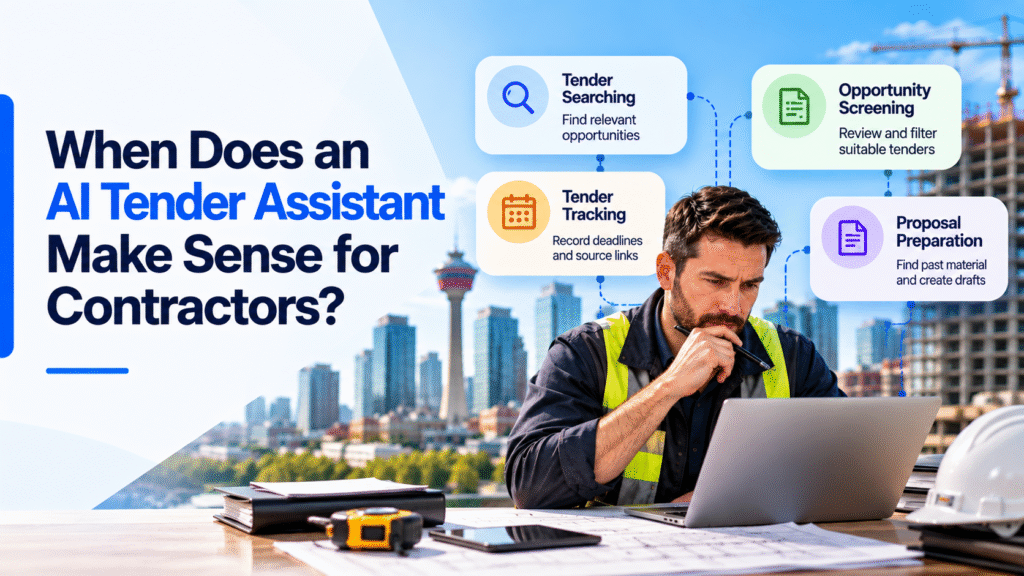
An AI tender assistant is worth evaluating when searching for opportunities and organizing tender information have become recurring administrative tasks.
Your estimator might check the same procurement portals every morning. Another employee copies tender details into a spreadsheet. The owner reviews opportunities that mention the right trade but fall outside the service area.
Once the team identifies a suitable opportunity, employees may spend additional time searching through previous proposals, qualifications, and project documents.
These activities create repeated work before anyone begins preparing the actual bid.
Start by tracking how much time your team spends on these activities during a representative working week.
Separate the work into four categories:
- Tender searching: Checking procurement portals and identifying new opportunities.
- Opportunity screening: Reviewing listings against your services, location, and business requirements.
- Tender tracking: Recording deadlines, source links, and review decisions.
- Proposal preparation: Finding previous material and preparing draft responses.
If your business submits bids occasionally and existing tender alerts meet your needs, a shared spreadsheet may be sufficient.
However, if employees repeatedly search multiple sources and prepare similar proposal sections, an AI workflow assessment can help determine which tasks are suitable for automation.
What Should an AI Tender Assistant for Contractors Handle?
An AI tender assistant should reduce repetitive searching and preparation work while leaving important business decisions with your team.
The workflow should support how tender opportunities move from initial identification to proposal preparation.
| Current Manual Task | AI Assistant Support | Human Responsibility |
|---|---|---|
| Repeatedly searching procurement portals | Monitor supported tender sources on an agreed schedule | Confirm source coverage and access |
| Reviewing unsuitable opportunities | Match listings against agreed business criteria | Review uncertain or borderline matches |
| Recording tender information | Save available details in a shared tracker | Review information and assign responsibility |
| Preparing repeated proposal sections | Create drafts using approved business material | Verify accuracy and tender requirements |
A general AI writing tool may help draft proposal content, but it does not automatically solve tender discovery and tracking problems.
If finding suitable opportunities is your main challenge, ask providers to demonstrate their tender monitoring and matching processes before evaluating their proposal-writing features.
What to Check Before Choosing an AI Tender Assistant Provider
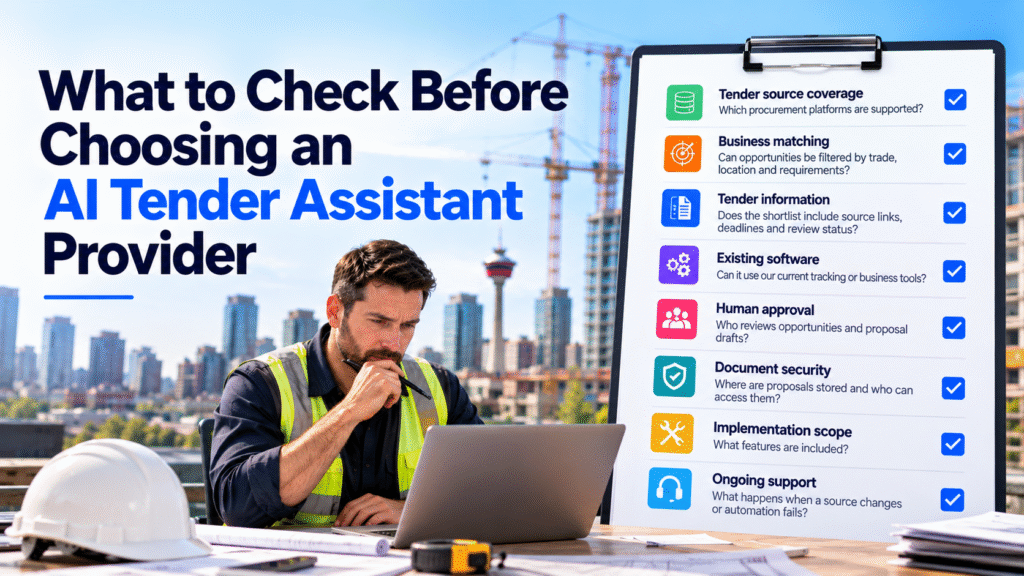
Choosing an AI tender assistant requires more than comparing features.
The provider should demonstrate how its workflow handles your specific tender sources, business requirements, and approval process.
For example, an electrical contractor pursuing commercial upgrades needs different opportunity-matching criteria from a plumbing company searching for maintenance contracts.
Use the following checklist when evaluating providers.
| Evaluation Area | Questions to Ask |
|---|---|
| Tender source coverage | Which procurement platforms are supported? Do they require account access? |
| Business matching | Can opportunities be filtered by trade, location, contract type, keywords, and exclusions? |
| Tender information | Does the shortlist include source links, available deadlines, and review status? |
| Existing software | Can the workflow use our current tracking or business tools? |
| Human approval | Who reviews opportunities and approves proposal drafts? |
| Document security | Where are uploaded proposals stored, and who can access them? |
| Implementation scope | What features are included, and what requires additional development? |
| Ongoing support | What happens when a source changes or automation fails? |
Confirm Tender Source Coverage
Source coverage matters because procurement opportunities appear across different platforms.
The City of Calgary’s official supply information directs suppliers to SAP Ariba Discovery and Alberta Purchasing Connection to view current purchasing opportunities.
Before choosing a provider, confirm whether its solution can monitor the sources relevant to your business and whether the permitted access methods support automation.
Do not assume every procurement platform can be monitored in the same way.
Test Opportunity Matching
Ask the provider to test its matching rules using examples of opportunities your business previously accepted and rejected.
The test should consider:
- Services and trades your company provides.
- Geographic service area.
- Preferred contract types.
- Relevant project requirements.
- Keywords and exclusions.
- Missing or unclear tender information.
The system should flag uncertain matches for human review rather than automatically treating every potential match as suitable.
Review Document Security and Data Handling
Previous proposals can contain company qualifications, project information, customer details, and other sensitive business records.
Before providing these documents, ask the provider about access permissions, retention periods, storage locations, AI processing, and deletion procedures.
Also confirm whether uploaded information is used for AI model training.
Obtain written answers before sharing confidential proposal material.
Choose a provider that clearly explains the workflow’s limitations and exceptions.
Your team should understand what happens when a source becomes unavailable, a tender description is incomplete, or an AI-generated draft contains information that cannot be verified.
If you need help defining these requirements, discuss your tender workflow with Diligentic.
How Should Contractors Review AI-Shortlisted Tender Opportunities?
An AI-generated tender shortlist should be treated as a starting point for evaluation, not a final decision to bid.
Before committing estimating time, a team member should open the original tender documents and verify the requirements.
Important checks include:
- Project scope: Does the work match your company’s services and capabilities?
- Eligibility requirements: Does the business meet mandatory qualifications and certifications?
- Closing deadline: What are the exact submission date, time, and applicable time zone?
- Tender amendments: Have any requirements or instructions changed?
- Available capacity: Can your team realistically deliver the work?
- Contract conditions: Are the commercial terms, insurance requirements, and payment arrangements acceptable?
- Submission instructions: Which documents and submission methods are required?
The Government of Canada’s guidance on preparing bids emphasizes reviewing mandatory requirements, monitoring amendments, and assessing business capability before deciding to bid.
Assign each shortlisted opportunity to a named reviewer.
Your tracking system can use simple decision statuses such as:
- Pursue: The opportunity appears suitable and is approved for further evaluation.
- Clarify: Additional information is required before making a decision.
- Decline: The opportunity does not meet your business requirements.
Record the reason for each decision alongside the original tender link.
This creates a clearer process for estimators, managers, and business owners.
How Diligentic Approaches AI Tender Automation
Diligentic’s AI Tender & Proposal Assistant is designed to help contractors reduce repetitive tender searching, organize opportunities, and prepare editable proposal drafts.
The workflow begins by defining which opportunities fit the contractor’s business.
1. Monitor Supported Tender Sources
The assistant checks agreed tender sources on a scheduled basis.
The specific sources and access requirements are established during scoping.
2. Match Opportunities to Business Requirements
Available opportunities are evaluated against agreed criteria such as services, trades, locations, and relevant keywords.
Listings that do not fit the requirements can be filtered out, while potential matches are organized for review.
3. Organize Opportunities in Google Sheets
Relevant tender information is saved in Google Sheets, giving team members a shared place to review opportunities, track details, and coordinate decisions.
4. Prepare Editable Proposal Drafts
For a selected tender, the solution can use relevant previous proposals and available business information to prepare an initial draft.
The draft is intended for human review rather than automatic submission.
5. Keep Final Decisions With the Contractor
Your team remains responsible for checking tender eligibility, confirming company information, reviewing proposal content, approving the final response, and submitting the bid.
The goal is to reduce repetitive preparation work without removing the checks required for accurate tender submissions.
A Tender Digest demonstration is available to show the tender-monitoring workflow.
If your company also needs tender information connected to another business system, Diligentic’s system integration services provide a starting point for discussing that requirement.
What Affects the Cost of an AI Tender Assistant?
The cost of implementing an AI tender assistant depends on the workflow’s complexity and the services included.
A scheduled tender search that adds matching opportunities to a spreadsheet has different requirements from a connected system that also prepares proposal drafts using business documents.
Several factors influence the scope.
Tender Source Access
Some sources may provide public information, while others require accounts, permissions, or specific access methods.
Additional access requirements can increase the work involved in implementation.
Business Matching Requirements
Basic filtering by trade and location may be relatively straightforward.
More detailed requirements involving contract types, exclusions, qualifications, and ambiguous descriptions may require additional configuration and testing.
Proposal Document Preparation
AI-assisted drafting requires relevant and current business information.
If previous proposals are outdated, inconsistent, or poorly organized, they may need to be reviewed before they can be used reliably.
Existing Software Integration
Connecting the tender shortlist to another tracking system, CRM, or internal workflow can add implementation requirements.
Testing and Ongoing Support
The scope should include appropriate testing, error handling, and an agreed support arrangement.
Before approving a project, request a written proposal explaining:
- Implementation deliverables and dependencies.
- Supported tender sources.
- Business matching and approval rules.
- Document storage and access requirements.
- Acceptance testing.
- Recurring platform or service charges.
- Ongoing maintenance and support.
The proposal should clearly distinguish initial implementation costs from recurring expenses.
How to Test an AI Tender Assistant Before Full Implementation
Testing should focus on whether the assistant produces information your team can actually use.
Begin with a representative sample of tender opportunities, including suitable listings and opportunities that should be excluded.
Evaluate the workflow against agreed acceptance criteria.
Test 1: Relevant opportunities
Confirm whether suitable opportunities appear in the shortlist.
Test 2: Unsuitable opportunities
Check whether the system correctly identifies opportunities that do not match your services or location.
Test 3: Missing information
Verify how the workflow handles missing deadlines, unclear descriptions, or incomplete tender details.
Test 4: Duplicate listings
Check whether the same opportunity appears multiple times across monitored sources.
Test 5: Source failures
Confirm how the system reports unavailable sources or unsuccessful searches.
Test 6: Proposal draft accuracy
Review whether the draft uses appropriate company information, addresses the selected tender requirements, and flags unsupported details.
Assign someone from your team to review the test results.
Compare the process with your previous manual approach before expanding automation to additional sources or tasks.
What to Prepare Before Discussing Tender Automation
A productive first conversation begins with a clear understanding of your current tender process.
Bring the following information:
- The procurement websites your company regularly checks.
- Your preferred trades, services, and project locations.
- Examples of suitable and unsuitable tender opportunities.
- Your existing opportunity tracker or spreadsheet.
- A representative tender your company has reviewed.
- The employees responsible for searching, evaluating, and approving bids.
- Previous approved proposals, if automated drafting is part of the discussion.
Explain which tasks take the most time and where information is frequently duplicated or delayed.
You do not need to automate the entire tender process at once.
Starting with one repeated activity, such as tender searching or opportunity tracking, makes it easier to define requirements and evaluate the output.
An AI tender assistant for contractors should provide a clear workflow, relevant information, and a practical review process.
If your business regularly searches for tenders or prepares proposals, Diligentic can help assess which parts of that process are suitable for automation.
Book a discovery call to discuss your tender sources, screening criteria, and repeated administrative tasks.
Frequently Asked Questions
Which tender sources can an AI tender assistant monitor?
Source coverage depends on the provider and the agreed implementation. Ask for a confirmed list of supported procurement platforms, including any required accounts, access permissions, and monitoring limitations.
Can an AI tender assistant find opportunities relevant to my trade and service area?
Yes, a suitably configured assistant can evaluate available listings against agreed criteria such as trades, services, locations, keywords, and contract types. Matches still require human review, particularly when tender descriptions contain incomplete or ambiguous information.
Can an AI tender assistant prepare proposals using previous company documents?
Diligentic’s published solution supports creating editable first drafts using relevant previous proposals and available business information. Your team must verify that the reused information is current, accurate, and appropriate for the selected tender.
Does an AI tender assistant automatically submit bids?
Diligentic’s published workflow keeps bid review, finalization, and submission with the contractor. The assistant supports discovery and preparation but does not replace the team’s final approval process.
Can an AI tender assistant guarantee successful tender bids?
No. Tender outcomes depend on eligibility, qualifications, pricing, evaluation criteria, competition, and the quality of the submitted response. Automation cannot guarantee a compliant proposal or a contract award.
How much does an AI tender assistant cost?
Costs depend on the number and accessibility of tender sources, matching requirements, proposal drafting features, document preparation, software integrations, and ongoing support. Request a written scope that separates implementation costs from recurring charges.
Is an AI tender assistant suitable for small contractors?
It can be suitable when repeated tender searching and preparation work justify the implementation effort. Smaller businesses that bid infrequently may find existing portal alerts and a shared tracker sufficient.
What should contractors automate first?
Begin with the repeated activity consuming the most administrative time. For some businesses, that is searching tender sources. For others, it is organizing shortlisted opportunities or preparing common proposal sections. Test one workflow before expanding further.
About the author
Ajay Kumar
Founder and Director
About the author
Ajay Kumar is the founder and director of Diligentic Infotech, a Calgary AI automation company. He has 9+ years of hands-on technical experience and now focuses on helping small and medium businesses connect their existing tools and cut down manual work through practical AI automation. He leads with a clear focus on real, working solutions over one-time demos.
Posted on 2 Dec 2025
AI Automation: The Most Impactful Use Cases Companies Can’t Ignore
AI Automation is not optional anymore. Companies that ignore it fall behind in speed, accuracy, and cost management. This guide breaks down the most practical, high-impact use cases of AI and automation with real examples, clear explanations, and honest trade-offs.
Posted on 30 Apr 2026
AI Automation Services for Modern Businesses: Proven Strategies to Improve Efficiency and Reduce Costs in 2026
AI Automation services help businesses improve efficiency and control costs by automating repetitive, data-driven tasks and speeding up processes. It enables teams to reduce manual effort, minimize errors, and focus on higher-value work. Depending on the use case, a significant portion of routine activities can be automated, leading to faster operations, better decision-making, and scalable growth.

Posted on 2 Sep 2026
How Storm Lead Surges Overwhelm Calgary Roofing Companies—and How AI Lead Automation Helps in 2026
A major hailstorm can send a sudden wave of roofing enquiries into a Calgary company within hours. The challenge is not only answering calls. It is capturing every lead, collecting the right information, identifying urgent cases, assigning the next step, and keeping records updated while the team is already busy.