SHARE

AI Email Assistant in Calgary: How Contractors Can Evaluate Costs, Providers & Implementation

Choosing the right AI email assistant in Calgary starts with understanding how it fits your business. HVAC, plumbing, electrical, and roofing contractors should evaluate customer record access, system integration, human review, and implementation costs before investing.
This guide helps you compare providers, assess key features, and make an informed buying decision.
Book your free workflow audit to discuss your existing email workflow and requirements.
Table of Contents
When Is an AI Email Assistant Worth Buying?
An AI email assistant is worth evaluating when employees repeatedly gather customer information and prepare similar responses.
For example, a plumbing office may need to locate an invoice before replying to a customer. An electrical contractor may need to verify the latest approved estimate.
Before investing, compare three approaches:
| Option | Suitable situation | Main consideration |
|---|---|---|
| Email templates | Standard responses requiring little customization | Customer-specific details still require manual checking |
| Built-in AI writing tools | Assistance with wording and email structure | Employees may need to provide context manually |
| Connected AI email assistant | Replies depend on information from supported business records | Integration, permissions, and testing affect implementation |
If templates already handle customer requests efficiently, a connected assistant may not justify the expense.
7 Checks Before Choosing an AI Email Assistant Provider
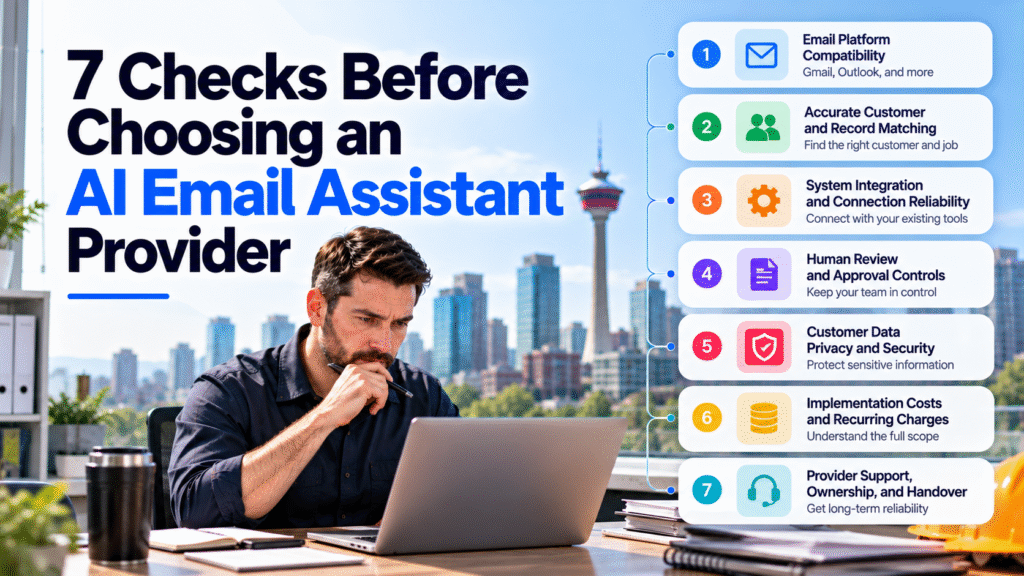
Use these criteria when comparing providers. Request written answers and demonstrations based on your existing business processes.
1. Email Platform Compatibility
Identify where customer emails arrive and where employees prepare responses.
The proposed assistant may need access to Gmail, Outlook, Google Workspace, or a shared support inbox.
Ask the provider:
- Which accounts and inboxes are supported?
- How are incoming messages selected?
- Where do completed drafts appear?
- How are existing email threads handled?
- What happens when the inbox connection fails?
General platform compatibility does not guarantee support for your exact account configuration.
Request a demonstration using the proposed setup.
2. Accurate Customer and Record Matching
A reliable draft depends on identifying the correct customer and associated business record.
Consider a plumbing customer who owns several properties and requests an invoice. Matching the customer name alone is insufficient. The workflow must identify the correct property and invoice.
Evaluate how the assistant handles:
- Customers with similar names.
- Multiple jobs under one account.
- Duplicate customer records.
- Outdated or conflicting information.
- Missing record identifiers.
The provider should demonstrate how uncertain matches are identified.
Buying criterion: Customer-specific information must not be used confidently when the record match remains unresolved.
3. System Integration and Connection Reliability
Customer matching establishes which record is correct. System integration determines whether the assistant can access the required information securely and reliably.
Contractors may maintain customer details, estimates, invoices, and job records in separate tools.
Ask the provider to document:
- Required business-system connections.
- Available APIs or integration methods.
- Access permissions and supported fields.
- How current information is retrieved.
- Connection failure detection and recovery.
Separate existing capabilities from connections requiring additional development.
If customer information is scattered across tools, system integration services may be relevant before implementing AI-assisted drafting.
Request a connection plan identifying each data source, purpose, and technical dependency.
4. Human Review and Approval Controls
Customer responses sometimes involve pricing, scheduling, warranty questions, or contractual commitments.
AI-generated drafts can contain incorrect information even when the wording appears professional.
A suitable approval process should allow employees to:
- Review customer and job information.
- Correct factual errors.
- Edit response wording.
- Verify commitments against approved records.
- Handle exceptional requests manually.
Establish which messages require escalation and who has authority to approve responses.
Buying criterion: The provider must demonstrate the agreed approval process before implementation.
5. Customer Data Privacy and Security
Customer correspondence can contain addresses, billing details, contact information, and internal job notes.
Before granting access, request written answers covering:
- Data storage and processing locations.
- Employee and provider access permissions.
- Information retention and deletion.
- Use of customer information for AI model training.
- Revocation of access when the service ends.
The Canadian privacy principles for generative AI provide guidance on responsible personal-information use, safeguards, and retention.
Assess these arrangements before sharing live customer correspondence.
6. Implementation Costs and Recurring Charges
Email assistant cost depends on the number of connected systems, workflow complexity, usage requirements, and support arrangements.
Compare the complete implementation scope rather than subscription prices alone.
| Cost component | What to confirm |
|---|---|
| Initial implementation | Configuration, supported email categories, and response rules |
| System integration | Connection setup, permissions, and data mapping |
| Platform usage | AI usage charges, subscription fees, and volume limits |
| Testing and training | Acceptance testing, documentation, and staff preparation |
| Ongoing support | Monitoring, maintenance, and included issue resolution |
| Future changes | New workflows or integrations that may require separate scope and charges |
Request CAD pricing, or confirm the billing currency and exchange-rate exposure.
A written proposal should distinguish one-time costs, recurring charges, and separately scoped work.
7. Provider Support, Ownership, and Handover
A successful demonstration does not establish how the workflow will perform after launch.
Confirm who is responsible for investigating errors, maintaining integrations, updating response rules, and supporting employees.
Establish ownership of connected accounts, configuration, documentation, and access credentials.
Ask what happens if your business changes providers or discontinues the service.
Request a written handover and support plan before approving implementation.
Discuss Your Requirements Before Selecting a Provider
If your Calgary contracting business is comparing AI email assistants, start with your existing inbox, customer records, and approval requirements.
Discuss your AI email assistant requirements with Diligentic to assess integration needs and define a suitable initial workflow.
How Calgary Contractors Should Test an AI Email Assistant
A provider demonstration should reflect real contractor workflows rather than generic customer service examples.
The following are hypothetical evaluation scenarios, not verified client results.
| Business | Test scenario | What to verify |
|---|---|---|
| HVAC | Customer asks whether maintenance is booked | Correct appointment record and confirmation status |
| Plumbing | Customer requests an invoice copy | Correct customer, property, and invoice |
| Electrical | Customer asks about a revised estimate | Current approved version and unresolved changes |
| Roofing | Customer asks whether damage is covered by warranty | Approved information without unauthorized coverage decisions |
Define Acceptance Tests
Test the proposed workflow under four conditions:
Complete information: The required records are available, correctly matched, and sufficient for drafting.
Missing information: The workflow identifies unavailable details instead of inventing an answer.
Ambiguous information: Conflicting records or uncertain customer matches are flagged.
Exception handling: Sensitive requests requiring business judgment are directed to the appropriate employee.
Measure factual errors, incorrect matches, manual corrections, and review time.
NIST’s 2024 Generative AI Profile identifies confidently presented false information (confabulation) as a generative AI risk.
Agree on acceptable test outcomes and responsibilities for correcting defects before approving wider use.
How to Evaluate Whether an AI Email Assistant Is Worth the Investment
The financial decision should reflect measurable work removed from the current process.
First, measure the time employees spend gathering information, drafting replies, checking records, and correcting errors.
Then compare those activities with the proposed AI-assisted workflow.
Net time saved = Previous total handling time − New total handling time
The new handling time must include employee review, corrections, and workflow administration.
Estimate potential capacity released using your actual email volume and observed time savings.
If translating time into financial value, apply your own labour costs. Distinguish released employee capacity from actual cash savings.
An assistant that generates drafts quickly may provide limited value if employees must repeat every lookup to verify the output.
Invest when representative testing demonstrates reliable results and the operational benefit reasonably justifies the full cost.
Where Diligentic Fits in Your Provider Evaluation
Diligentic Infotech provides an AI Customer Support Email Assistant that reads supported incoming messages, checks available order or account information, and prepares editable response drafts.
Employees retain control of the final response.
Its published connection categories include shared inboxes, CRM platforms, helpdesk tools, order systems, spreadsheets, and custom APIs. Specific contractor-system access and permissions require confirmation during scoping.
The recorded AI Customer Support Email Assistant demonstration illustrates the drafting workflow. It demonstrates capability, not measured savings or a verified contractor implementation.
Diligentic also provides an AI Workflow Assessment to review repetitive work, information requirements, integration dependencies, and implementation options.
When evaluating Diligentic, use the same provider criteria, acceptance tests, security requirements, and commercial expectations applied to other providers.
Prepare a Buying Brief Before Requesting a Proposal
A short buying brief helps providers prepare comparable proposals.
Document the email categories you want included, existing inboxes, required customer records, business tools, approval responsibilities, and exception-handling requirements.
Include your current handling-time baseline and expected acceptance tests.
Request a proposal covering the defined scope, dependencies, implementation charges, support arrangements, and ownership responsibilities.
For Calgary contractors, the goal is to select a provider that can demonstrate a reliable workflow using the information and processes your business already maintains.
Discuss your AI email assistant requirements with Diligentic to determine an appropriate starting scope.
Frequently Asked Questions
1. How much does an AI email assistant in Calgary cost?
Costs depend on inbox access, required integrations, response rules, usage, testing, and support. Request a proposal separating initial and recurring charges.
2. Can an AI email assistant access our existing CRM and customer records?
Access depends on the available integrations, permissions, supported data fields, and agreed implementation scope. Ask the provider to demonstrate the required records.
3. What is the difference between a built-in AI writing tool and a connected assistant?
A built-in writing tool primarily helps prepare messages using context available within its environment. A connected assistant can use additional supported business information when those connections are implemented.
4. Does Diligentic’s AI Customer Support Email Assistant send emails automatically?
No. Diligentic’s current solution prepares editable drafts. Employees review and send the final response.
5. What should contractors request before approving implementation?
Request defined requirements, supported connections, data-handling terms, acceptance tests, responsibilities, and an itemized commercial proposal.
About the author
Ajay Kumar
Founder and Director
About the author
Ajay Kumar is the founder and director of Diligentic Infotech, a Calgary AI automation company. He has 9+ years of hands-on technical experience and now focuses on helping small and medium businesses connect their existing tools and cut down manual work through practical AI automation. He leads with a clear focus on real, working solutions over one-time demos.
Posted on 19 Oct 2026
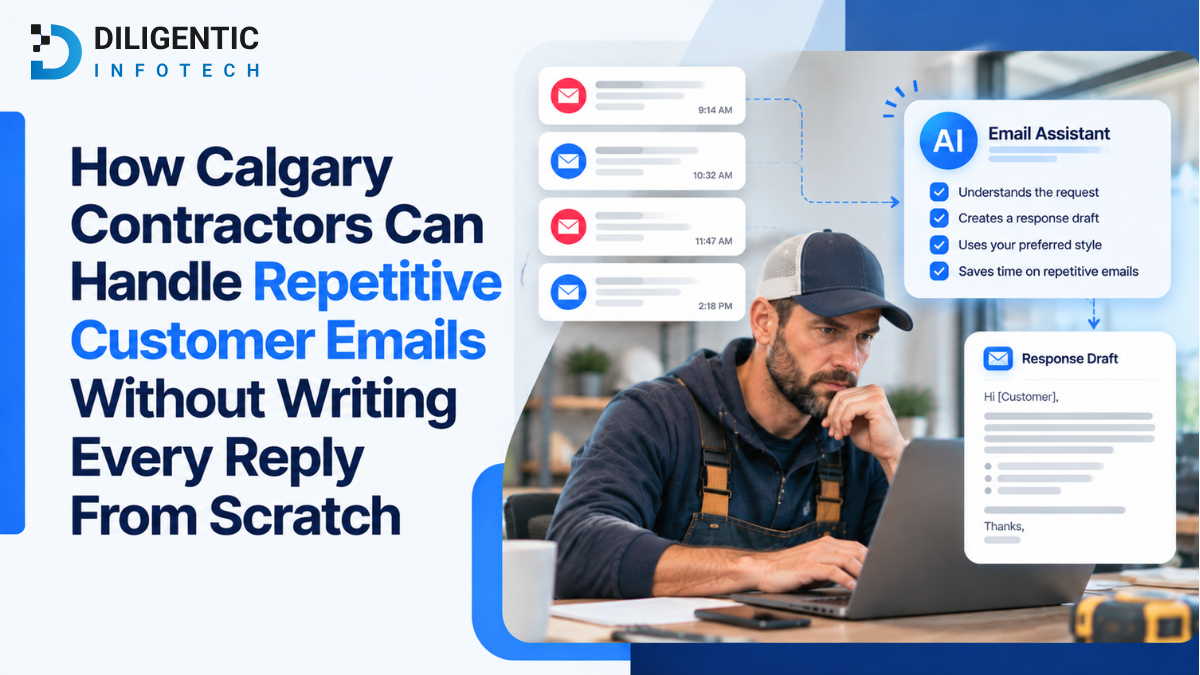
How Calgary Contractors Can Handle Repetitive Customer Emails Without Writing Every Reply From Scratch
Repetitive customer emails for contractors often create the same office work under different subject lines. A question may look new because the wording changes, while the appropriate reply follows an established business rule. If employees repeatedly build those replies from scratch, start by identifying the pattern before deciding whether templates or AI-assisted drafts will help.
Posted on 15 Oct 2026
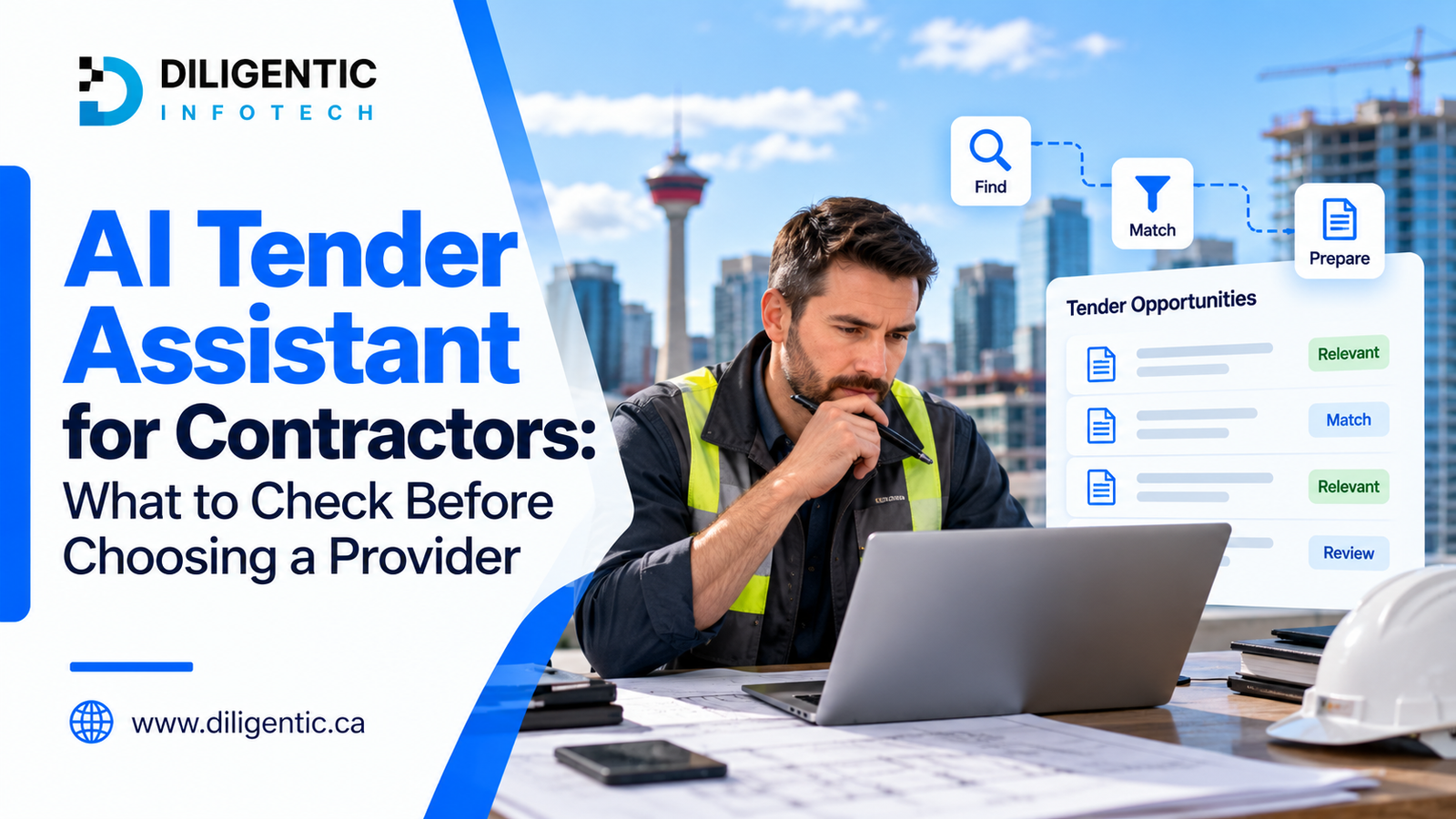
AI Tender Assistant for Contractors: What to Check Before Choosing a Provider
An AI tender assistant for contractors helps businesses find relevant tender opportunities, organize shortlists, and prepare proposal drafts for human review. Before choosing a provider, check which tender sources the assistant supports, how it matches opportunities to your business, and which decisions remain with your team.
Posted on 12 Oct 2026
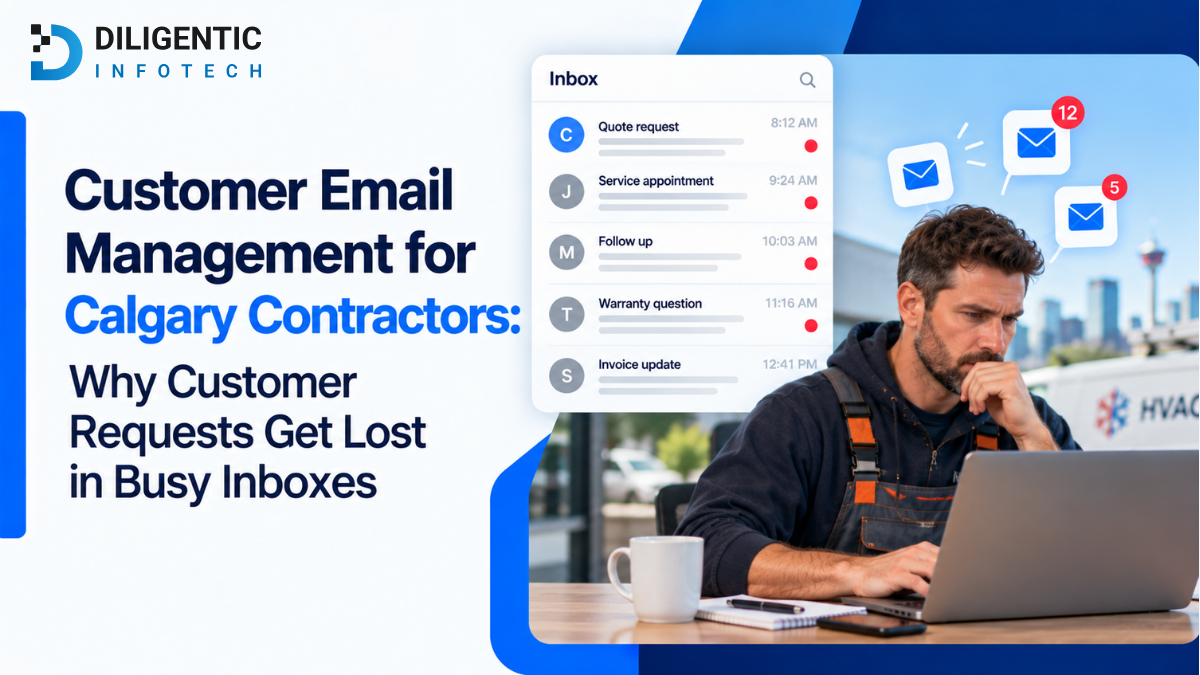
Customer Email Management for Calgary Contractors: Why Customer Requests Get Lost in Busy Inboxes
Customer email management for contractors means making every customer request visible, assigned, and ready for the right next action. A busy inbox becomes a problem when your team can read a message yet still lose track of the work it requires.