SHARE

How Calgary Electrical Contractors Can Reduce Time Lost to Manual Job Updates

Electrical contractors lose time when job details have to be repeated between technicians, dispatch and the office. Electrical workflow automation can move routine updates, flag missing records and show who needs to act next. The value depends on where the delay occurs: office administration, a technician interruption or work waiting to be invoiced.
Those are different costs. A dispatcher copying a job address spends office time. An electrician calling for missing site instructions loses field time. A completed job waiting for material details delays invoice preparation. Measure them separately before claiming that automation has recovered billable hours.
Table of Contents
Find out who is waiting for whom
A job may appear current in one tool while another person is working from an older update. The schedule shows a new appointment time, but the electrician received the original one. The technician has completed the work, but billing cannot see the parts used. The office then calls or messages someone to establish what happened.
Follow a few recent jobs and write down each avoidable contact. Who asked for information? Where did the correct detail already exist? What action was delayed while someone looked for it?
This identifies a more useful starting point than a broad plan to connect every system. Diligentic’s electrical contractor page covers the estimating, dispatch and invoicing handoffs where these questions often arise.
One electrical job, three different delays
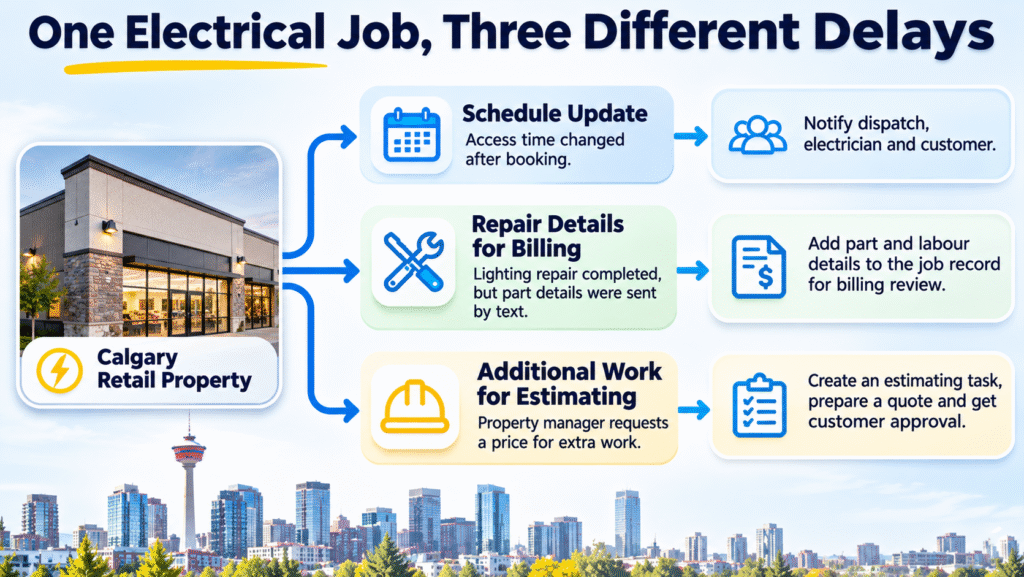
Consider a hypothetical service visit at a Calgary retail property. The property manager moves the access time after the appointment is booked. The electrician completes a lighting repair but sends the replacement-part detail to the office by text. While on site, the manager also asks for a price on additional work.
The schedule change needs to reach dispatch, the electrician and the customer. The replacement part belongs in the completed repair record so billing can check the invoice. The request for additional work belongs with an estimator or project lead; it does not become a charge on the repair invoice without the approval required by the agreement.
Without clear handoffs, the office may contact the electrician several times about the same visit. A defined workflow can distribute the confirmed schedule change, ask for the missing part detail and create a separate estimating task. Employees still confirm the price, customer decision and invoice exceptions.
This example is hypothetical. Whether any of the electrician’s interruptions would have been billable depends on the job and contract. The contractor should record the time before describing it as lost billable work.
Give each update a source and an owner
Start with the records the team already uses. Decide where the confirmed appointment lives, where field work is documented and which tool holds the invoice status. Use the same job identifier when an update moves between them.
Then define what happens at each event:
- A confirmed appointment change sends the approved time to the people who need it.
- A job marked complete triggers a check for required hours, materials and notes.
- A missing detail creates a task for the person who can supply it.
- An approved billing record moves to an invoice draft or the required employee review.
- A failed transfer alerts someone who can correct it.
A completion status alone should never be treated as proof that a job is ready to bill. Changed scope, missing materials and contract requirements may still need attention.
Diligentic’s process automation service addresses these triggers, assignments and exception paths. The contractor sets the rules; the workflow applies them to routine cases.
Use AI where the information is unclear
Moving a confirmed appointment or checking an empty field does not require AI. Defined rules are usually better suited to those tasks.
AI may help interpret a technician note that says, for example, “manager asked about more lights in the back.” It could flag the note as a possible estimating request and show the original wording to an employee. The employee checks whether work was performed, what the customer requested and who should follow up.
AI may also assist with an estimate draft using approved company information. An authorized person remains responsible for the final price and customer approval. Electrical safety and compliance decisions remain with qualified people.
Connect tools only after the handoff is clear
A connection can reduce repeated entry when the tools can share reliable job data. Before building it, check access permissions, available integrations, field definitions and what happens if two records disagree.
Test ordinary jobs and exceptions. A rescheduled visit, duplicate customer name, missing part and rejected accounting update should each produce an understandable result. If a transfer fails silently, the office may spend more time finding the problem than the connection saves.
Diligentic’s system integration service is relevant when existing scheduling, job and accounting tools need to exchange approved information. A new platform may still be appropriate when current tools cannot support the required process, but that decision should follow the workflow review.
Measure time recovered without overstating the result
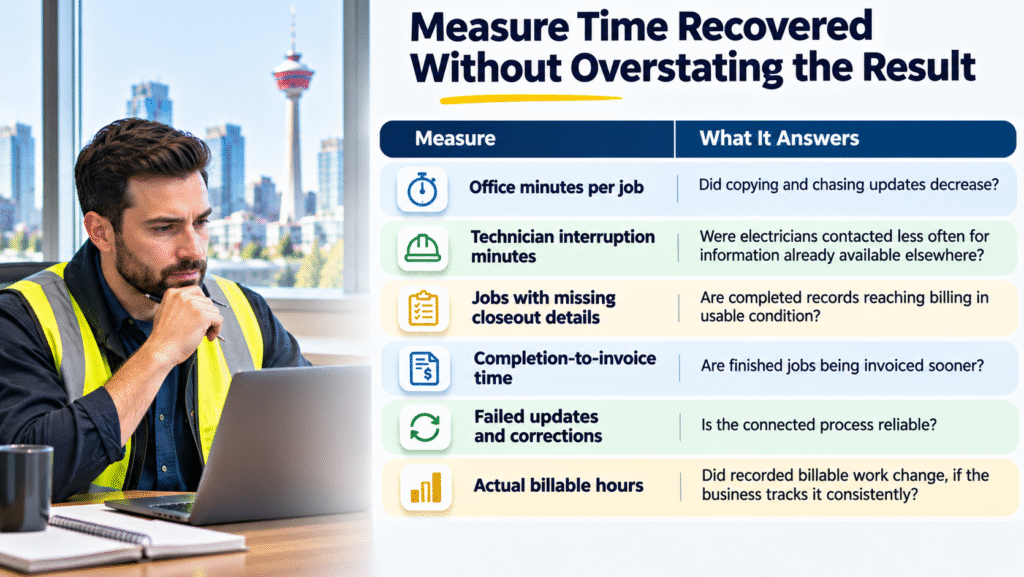
Choose a group of similar jobs before and after the change. Track a small set of measures:
| Measure | What it answers |
|---|---|
| Office minutes per job | Did copying and chasing updates decrease? |
| Technician interruption minutes | Were electricians contacted less often for information already available elsewhere? |
| Jobs with missing closeout details | Are completed records reaching billing in usable condition? |
| Completion-to-invoice time | Are finished jobs being invoiced sooner? |
| Failed updates and corrections | Is the connected process reliable? |
| Actual billable hours | Did recorded billable work change, if the business tracks it consistently? |
Do not add office minutes and technician minutes together and call the total “billable hours recovered.” Some interruptions may occur during paid work, some may not displace another job, and some may still require employee review.
A shorter completion-to-invoice interval means the payment request goes out sooner. Customer payment timing is a separate measure. Staff time returned to the business is capacity; it becomes a cash saving only if an actual cost falls.
When the answer is a person or a process change
Not every delay needs an integration. A short field closeout checklist may solve a recurring missing-note problem. A named estimator may resolve new-work requests that sit without an owner.
Hiring can be the better decision when the team faces sustained customer-service demand, complex dispatch decisions or more estimating work than current employees can handle. Automation may support that employee by removing repeated updates, but it cannot provide the same judgment or customer attention.
Review the work remaining after the routine steps are improved. That makes a staffing decision more reliable than judging it from a busy week alone.
Frequently asked questions
Does electrical workflow automation increase billable hours?
It may reduce interruptions and make more field time available. Whether billable hours actually rise depends on scheduling, demand, contract terms and how the company records time. Measure the result rather than assuming it.
Can automation send an invoice when an electrician closes a job?
Only if the contractor’s required billing details and approvals are complete. Otherwise, the workflow should identify what is missing and assign the next action.
Do contractors need to replace their job management tools?
Not necessarily. Existing tools may be connectable, depending on their access and data quality. A clearer process may also solve some problems without a new connection.
What is the best first workflow to improve?
Choose a repeated handoff with a clear owner and a measurable delay. Schedule changes, field closeout and invoice readiness are possible starting points.
Start with one job update that keeps getting chased
Review recent calls between the field and office. Find one update that staff repeatedly request, decide where it should be recorded and give exceptions an owner. Test that change before connecting more steps.
Diligentic can review a Calgary electrical contractor’s current tools and the handoff consuming the most time. Book a qualifying call to discuss your field-to-office workflow. If there is a fit, an in-person workflow audit can be arranged in Calgary after the call.
About the author
Ajay Kumar
Founder and Director
About the author
Ajay Kumar is the founder and director of Diligentic Infotech, a Calgary AI automation company. He has 9+ years of hands-on technical experience and now focuses on helping small and medium businesses connect their existing tools and cut down manual work through practical AI automation. He leads with a clear focus on real, working solutions over one-time demos.

Posted on 5 Nov 2026
How Calgary Electrical Contractors Can Reduce Double Data Entry by Connecting Their Software
An electrical contractor should not have to type an approved customer address into an estimate, then again into a work order, schedule and invoice. Electrical business software integration connects those handoffs so the right record can move at the right time. It can eliminate re-entry at a defined step, provided the tools can exchange dependable data and someone handles exceptions.

Posted on 17 Nov 2026
How Electrical Invoicing Automation Helps Calgary Contractors Bill Sooner
Electrical invoicing automation helps Calgary contractors send invoices sooner by collecting job details, checking for missing information and moving approved records to billing. It is most useful when finished work regularly waits for someone in the office to track down hours, materials or customer approvals. Faster invoice preparation gives the customer a payment request earlier, although it does not guarantee an earlier payment.

Posted on 22 Jul 2026
Why Electrical Companies Calgary Are Struggling to Scale Without Connected Business Systems in 2026
Many electrical companies Calgary struggle to scale not because they lack software, but because the software they already use operates separately. Scheduling, dispatch, CRM, accounting, invoicing, estimating, GPS tracking, and field operations often sit in different systems with weak information flow between them.