SHARE

How Electrical Invoicing Automation Helps Calgary Contractors Bill Sooner

Electrical invoicing automation helps Calgary contractors send invoices sooner by collecting job details, checking for missing information and moving approved records to billing. It is most useful when finished work regularly waits for someone in the office to track down hours, materials or customer approvals. Faster invoice preparation gives the customer a payment request earlier, although it does not guarantee an earlier payment.
Table of Contents
The delay often starts at job closeout
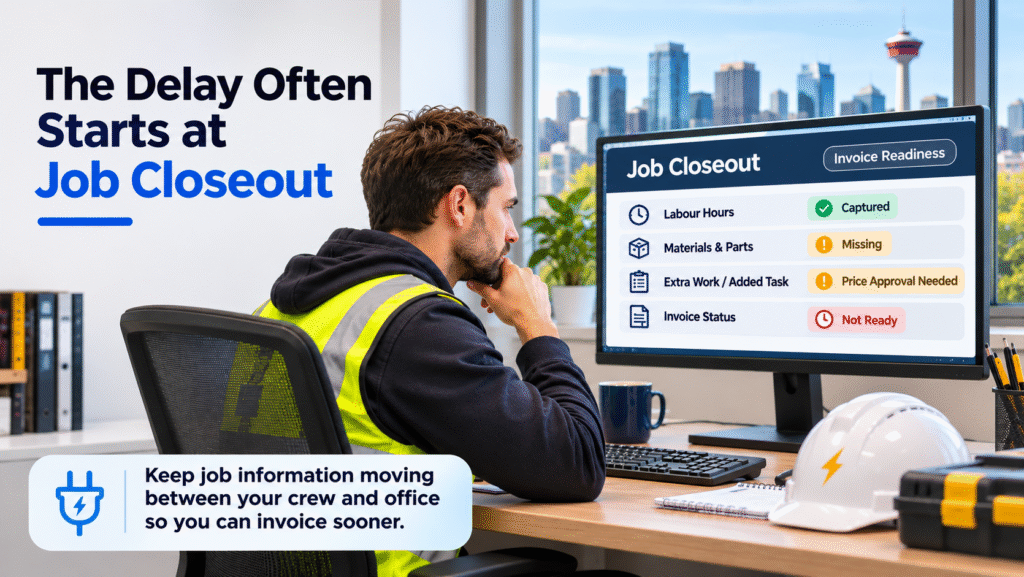
An electrician can finish the work while the invoice is still missing essential details. Labour hours may be in a field report, a part may appear only on a supplier receipt, and an added task may be described in a message without an approved price.
The office must resolve those gaps before it can bill accurately. When several people handle a job, nobody may realize the invoice is waiting until days later. The first improvement is visibility: every completed job should show whether it is ready to bill, what is missing and who owns the next action.
Diligentic’s electrical contractor solutions address the movement of job information between crews and office teams. Contractors can start by identifying the records their existing process already collects and where those records get delayed.
Build a billing record around the job
A useful billing record brings together the information needed to explain the charge to the customer. For a routine service job, that may include the accepted estimate, work completed, labour, materials and customer details. A larger project may also need a purchase-order reference, progress milestone or approved change.
The requirements should match the job type. A short repair does not need the same review path as a commercial project with several crews and staged billing. Define the minimum record for each common type of work, then decide which exceptions require an employee.
That decision matters more than collecting extra fields. If a crew has to fill out a long form that nobody uses, closeout may take longer without making invoices more accurate.
One Friday job, two different billing questions
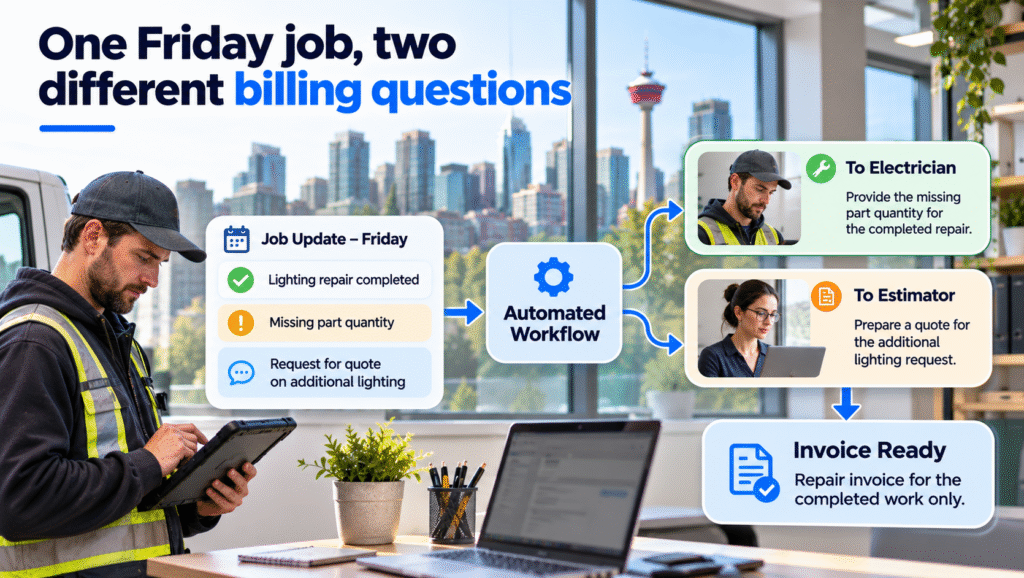
Consider a hypothetical Calgary contractor finishing a lighting repair on Friday afternoon. The electrician records the completed repair but forgets to enter the quantity of replacement parts. The property manager also asks for a quote on additional lighting in another area.
The missing part quantity belongs to the finished repair and must be checked before billing. The request for additional lighting is a separate opportunity; it should go to the person responsible for estimating. It should not be added to the repair invoice as though the customer approved a price.
An automated workflow can route each item correctly. The electrician receives a request for the part quantity. The estimator receives the new-work request. Once the repair record is complete, billing can prepare that invoice under the agreed terms without waiting for the separate quote.
3 Ways Electrical Invoicing Automation Reduces Delays
1. Alert the office when an invoice draft fails to reach accounting.
2. Check the job record for required hours, materials and closeout notes.
3. Send changed scope or missing customer approval to the responsible employee.
Rules work well for information with a clear answer. When a job is marked complete, the workflow can check whether required fields are filled, the accepted price is available and any chargeable change has a recorded approval. It can then create a task for the person responsible for a missing item.
A complete record can move to an invoice draft. If the transfer to accounting fails, the job should remain in a visible queue with an owner. Otherwise, the team may assume the invoice is moving forward when it has stopped between tools.
Diligentic’s process automation service focuses on these triggers, tasks and approval steps. The contractor decides which conditions must be met; the workflow applies those decisions consistently.
AI can assist with notes that do not fit a fixed field. For example, it could flag “customer asked us to move the fixture” as a possible scope change. An employee still needs to check what work was performed and whether the customer approved the charge. AI should not decide the price or treat a casual site conversation as authorization.
Keep billing approvals with the right people
Some invoices can follow a routine path once their records are complete. Others need a project lead or billing employee because the scope changed, the amount is disputed or the contract has a specific billing milestone.
Write down who can release each invoice type and what sends a job to review. Test those rules with a missing material entry, an unapproved change and an accounting transfer failure. The result should be a clear task for a named person, not an invoice containing a guessed amount.
If field and accounting tools can share approved job data, system integration may remove repeated entry. The connection also needs to detect failed updates and prevent duplicate records. Its value depends on the contractor’s current tools and the quality of the information entered at the job.
Measure the time saved at the right point
Track the interval from job completion to invoice delivery before and after changing the process. Also record why each invoice waited. A shorter average is useful, but the reasons show whether the change solved the recurring problem.
Keep payment timing as a separate measure. If invoices go out sooner but customers still take longer than the agreed terms to pay, the contractor may need to review disputes and follow-up. If employees spend less time searching for records, count that as capacity returned to the team. It is a cash saving only when an actual cost falls.
A practical starting sample is ten completed jobs of a similar type. Review their closeout dates, invoice dates and billing holds. That evidence can show whether a clearer checklist will do the job or whether a connection between tools is justified.
Frequently asked questions
Does electrical invoicing automation send every invoice automatically?
It can, but it should follow the contractor’s documented rules. Jobs with missing records, changed scope or disputed charges may need employee review before an invoice is released.
Can automation correct inaccurate field notes?
It can flag an unclear or inconsistent note. The electrician or another responsible employee must confirm what happened before the billing record is changed.
Will earlier invoices make customers pay sooner?
Earlier delivery starts the customer’s review or payment process sooner. The actual payment date still depends on the agreed terms, the customer and any dispute.
What should a contractor fix first?
Look for the reason completed jobs most often wait in the billing queue. Fix that handoff, assign an owner and measure the result before automating additional steps.
Make the next invoice easier to send
Start with the jobs completed this week. Check which ones are ready to bill, which need a record and which need an approval decision. Once those categories are clear, electrical invoicing automation can move routine work forward and bring exceptions to the right person.
Diligentic can review the path from field completion to invoice delivery and identify a practical first improvement. Book a qualifying call to discuss your billing workflow. If there is a fit, Ajay can arrange an in-person workflow audit in Calgary after the call.
About the author
Ajay Kumar
Founder and Director
About the author
Ajay Kumar is the founder and director of Diligentic Infotech, a Calgary AI automation company. He has 9+ years of hands-on technical experience and now focuses on helping small and medium businesses connect their existing tools and cut down manual work through practical AI automation. He leads with a clear focus on real, working solutions over one-time demos.

Posted on 22 Jul 2026
Why Electrical Companies Calgary Are Struggling to Scale Without Connected Business Systems in 2026
Many electrical companies Calgary struggle to scale not because they lack software, but because the software they already use operates separately. Scheduling, dispatch, CRM, accounting, invoicing, estimating, GPS tracking, and field operations often sit in different systems with weak information flow between them.

Posted on 6 Nov 2026
How AI Automation Helps Calgary Electrical Companies Connect Scheduling, Invoicing, and Field Operations in 2026
AI automation for electrical companies can help a Calgary office turn free-form field notes into reviewable updates while connected rules move approved job details between scheduling and invoicing. Consider a crew that finishes work while the schedule still shows the job as open and the office is waiting for hours, materials and change approvals. AI can flag missing details or possible scope changes; employees confirm them before billing moves forward.

Posted on 10 Nov 2026
How Calgary Electrical Contractors Can Protect Profit Margins as They Grow
More electrical jobs do not always mean more profit. If labour, materials and overhead rise faster than revenue, a Calgary electrical contractor can be busier while keeping less from each dollar earned. The way to find out why is to compare accepted estimates with the full cost of completed jobs, then fix the repeated gaps.