SHARE

How Calgary Electrical Contractors Can Protect Profit Margins as They Grow

Electrical contractor profit margins can fall even as a Calgary business takes on more jobs. When labour, materials and overhead rise faster than revenue, the contractor keeps less from each dollar earned. Compare accepted estimates with completed-job costs to find where the gap begins.
Those gaps are often easy to describe but hard to see in time: extra hours recorded late, a customer change approved in a text, materials bought for one job but charged to another, or a completed job waiting for paperwork before it can be invoiced. Each deserves a different response. Start with the numbers before adding another tool.
Table of Contents
How revenue can rise while operating margin falls
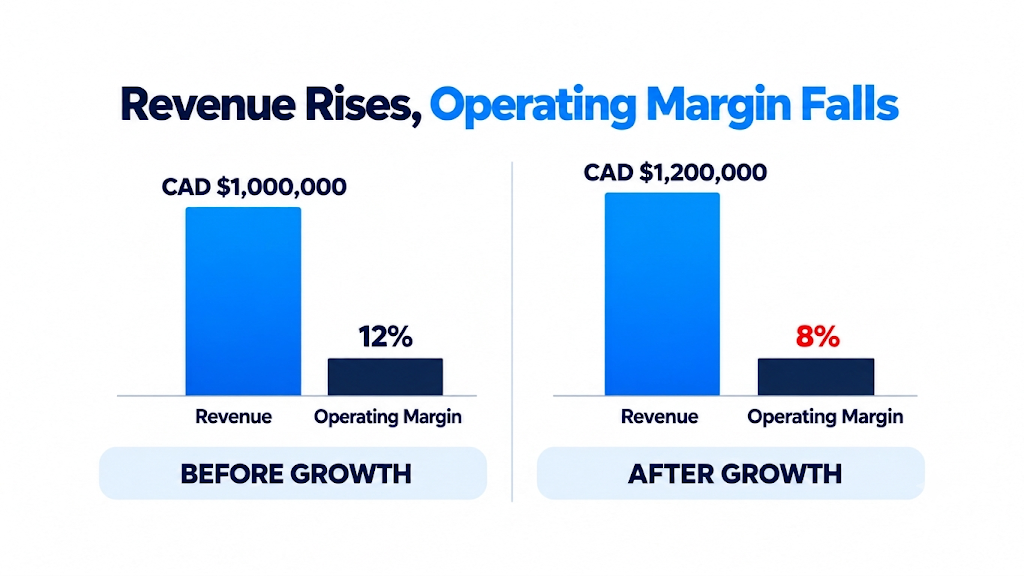
Operating margin is the share of revenue left after direct job costs and operating overhead. It is different from markup, which compares price with cost. For the examples in this article:
Operating margin = (revenue − direct job costs − operating overhead) ÷ revenue × 100
Direct job costs include labour and materials. Operating overhead may include office wages, vehicles and other running costs. The following figures are hypothetical, exclude interest and income tax, and are not a benchmark for Calgary contractors.
| Hypothetical period | Revenue | Direct job costs | Operating overhead | Operating profit | Operating margin |
|---|---|---|---|---|---|
| Before growth | CAD $1,000,000 | CAD $700,000 | CAD $180,000 | CAD $120,000 | 12% |
| After growth | CAD $1,200,000 | CAD $870,000 | CAD $234,000 | CAD $96,000 | 8% |
Revenue grew by CAD $200,000. Combined costs grew by CAD $224,000, leaving CAD $24,000 less operating profit. The owner now has more work to manage and less profit to show for it.
Compare similar jobs across the two periods. Did actual crew hours rise? Were materials priced accurately? Did added office work or extra vehicles increase overhead? Company-wide margin shows the overall change; job-level records help explain its cause.
The costs that appear after an electrical quote is accepted
The accepted estimate is a starting point, not the final cost of the job. A service call or small commercial upgrade can change after the electrician reaches the site. The team may need more time, use additional materials, return for corrective work or complete a customer-requested extra.
The risk grows when the records behind those decisions do not travel together. The electrician has a work order, the estimator has the original scope, the customer sends a text, and the office has a separate invoice record. If nobody joins them, the business may absorb a chargeable change or miss the reason a job ran over budget.
A useful record for each job should show the accepted price and scope, actual hours and materials, approved changes, callbacks, and a consistent share of overhead. Diligentic’s electrical contractor page describes the related estimating and field-to-office handoffs.
What an added circuit does to a job’s margin
Hypothetical example, not a client result. A contractor accepts a small upgrade for CAD $5,000. The estimate includes CAD $2,000 in labour, CAD $1,000 in materials and CAD $1,000 in allocated overhead. Expected operating profit is CAD $1,000, or 20% of the price.
On site, the customer asks for another circuit. The electrician estimates CAD $300 more labour and CAD $200 more materials. If the crew completes it without an agreed price, job cost rises to CAD $4,500 while revenue stays at CAD $5,000. Operating profit falls to CAD $500, a 10% margin.
Now consider an approved CAD $700 change. Assuming the added costs are exactly CAD $500 and no other costs change, revenue becomes CAD $5,700 and operating profit becomes CAD $1,200. The resulting margin is about 21.1%. That is an illustration of the approval’s effect, not a suggested price or a promised outcome.
Before starting the extra work, the electrician records what the customer requested and the likely labour and materials. The office prices the change and seeks the customer’s authorization through its usual process. The crew receives the decision, and the approved amount is added to the job and invoice records. If the customer declines, the contractor decides how to handle the original scope under the agreed terms. The crew should never infer approval from an informal site note.
Late invoices create cash-flow pressure, even when a job is profitable

A job with a positive estimated margin can still strain cash when wages and suppliers are paid before the customer pays. Waiting to prepare an invoice extends that gap. The timing of revenue and profit recognition depends on the contractor’s accounting method, so review payment timing separately from the job-cost calculation.
An invoice may sit unfinished because the office still needs the crew’s completion note, recorded hours, material costs or proof of an approved change. A simple closeout list can show what is missing and who must provide it. The person responsible for billing then checks the completed record against the contract before issuing the invoice. This removes an internal delay, although the customer’s payment date remains outside the contractor’s control.
Where records are kept in different tools, Diligentic’s system integration service may help connect the job and accounting steps. The right connection depends on what those tools can share reliably.
Review ten finished jobs to find the recurring gap
Choose ten recently completed jobs of the same type. Put the accepted estimate, final costs and approval history side by side for each one. Use this short checklist so every job gets the same review:
| Check | Question to answer |
|---|---|
| Labour variance | Did actual hours exceed estimated hours? |
| Material variance | Were extra materials used or purchases assigned to the wrong job? |
| Change approvals | Were chargeable changes priced and approved before billing? |
| Callbacks | Did the crew return for unplanned corrective work? |
| Invoice readiness | Were required records missing when the work ended? |
| Actual margin | How did final operating margin compare with the estimate? |
Calculate each final margin using the same cost categories and a consistent method of allocating overhead. Mark the largest gap for each job, then look for a pattern across the ten. If only one job went badly because of an unusual site condition, that suggests a different response from repeated labour overruns on the same service type.
Match the remedy to the cause. Repeatedly underestimated labour calls for a better estimating assumption or work plan. Missing material entries call for a clearer field process. Approved changes that never reach the invoice point to a broken handoff. The field-service operations guide gives a wider view of how office and field records move through a job.
Track the time spent finding and correcting information as well. Returning an hour to an administrator creates staff capacity; it becomes a cash saving only if an actual cost falls. Compare realistic benefits with implementation and ongoing support costs before claiming a return on investment.
Connect the handoff that repeatedly breaks
After the ten-job review, choose one repeat problem. If charge approvals are the issue, a rule can create a task when an electrician reports extra work, carry the approved amount into the job record and flag it for invoice review. If a transfer fails or the approval is missing, the job stays visible with a named owner.
AI has a narrower role. It could read a variable field note and suggest that the note describes extra scope, with the original text attached for review. An employee decides whether it is a change, what to quote and what the customer has authorized. Pricing, electrical safety and customer commitments stay with qualified people.
Test the proposed handoff against ordinary jobs and exceptions: a missing receipt, an unclear request, a declined change and a failed record transfer. Measure both time saved and time spent checking the output. A process that hides errors can make margin reporting worse, even if it moves data quickly.
Find the margin gap worth fixing first
If sales are growing but operating margin is falling, start with ten comparable jobs and the six checks above. The answer may be in estimating, field records, change approvals, callbacks or overhead. Once the cause is visible, the contractor can decide whether to change a process, connect existing tools or add an AI-assisted review step.
Diligentic’s AI workflow assessment can help map the field-to-office steps and identify a practical place to start.
Book a qualifying call about your electrical job workflow. If there is a fit, Ajay can arrange an in-person workflow audit in Calgary after the call.
Frequently asked questions
How often should an electrical contractor review job margins?
Review costs when each job closes, while the crew can still explain unusual hours or purchases. Compare similar completed jobs regularly to spot patterns in estimating or recordkeeping.
What if a completed job has missing time or material records?
Treat its margin as provisional. Ask the person closest to the work to confirm the missing information before drawing conclusions about profitability.
Does sending an invoice sooner improve profit margin?
Sending an invoice sooner can reduce the wait before payment, but it does not reduce the job’s labour, material or overhead costs. Review cash flow and job profitability separately.
When is automation worth considering for margin tracking?
Consider it when the same handoff fails across several jobs and the underlying records are reliable. Define who approves changes and handles exceptions before connecting the workflow.
About the author
Ajay Kumar
Founder and Director
About the author
Ajay Kumar is the founder and director of Diligentic Infotech, a Calgary AI automation company. He has 9+ years of hands-on technical experience and now focuses on helping small and medium businesses connect their existing tools and cut down manual work through practical AI automation. He leads with a clear focus on real, working solutions over one-time demos.

Posted on 21 May 2026
How Field Service Management Software Improves HVAC, Plumbing, and Electrical Operations
Field service management software connects the work that happens in the office with the work technicians complete in the field. It gives HVAC, plumbing, and electrical businesses one reliable process for receiving a service request, assigning the right person, recording job details, invoicing the customer, and reviewing performance.

Posted on 5 Nov 2026
How Calgary Electrical Contractors Can Reduce Double Data Entry by Connecting Their Software
An electrical contractor should not have to type an approved customer address into an estimate, then again into a work order, schedule and invoice. Electrical business software integration connects those handoffs so the right record can move at the right time. It can eliminate re-entry at a defined step, provided the tools can exchange dependable data and someone handles exceptions.

Posted on 22 Jul 2026
Why Electrical Companies Calgary Are Struggling to Scale Without Connected Business Systems in 2026
Many electrical companies Calgary struggle to scale not because they lack software, but because the software they already use operates separately. Scheduling, dispatch, CRM, accounting, invoicing, estimating, GPS tracking, and field operations often sit in different systems with weak information flow between them.