SHARE

Why Calgary HVAC Companies Are Replacing Spreadsheets with Game-Changing Custom Service Software in 2026

TL;DR
Calgary HVAC companies are replacing spreadsheets and disconnected systems because manual workflows slow operations, reduce visibility, increase errors, and make growth harder to manage. Custom HVAC software helps businesses centralize dispatching, invoicing, technician management, customer communication, maintenance tracking, reporting, and operational workflows into one connected system designed around how the company actually operates.
Many HVAC companies reach a stage where spreadsheets, disconnected apps, and manual coordination start creating operational bottlenecks. Teams spend more time updating records, transferring information between systems, and fixing communication gaps than focusing on customer service and operational efficiency.
As service demand grows, managing dispatching, invoicing, maintenance schedules, inventory, customer communication, technician coordination, and reporting through disconnected processes becomes increasingly difficult.
This is why many HVAC companies in Calgary are investing in custom HVAC software built around their specific workflow, operational structure, approval process, reporting needs, and long-term growth plans.
Instead of forcing teams to adapt to rigid software limitations, custom software allows businesses to operate the way they actually need to work.
This article explains why HVAC companies in Canada are moving away from spreadsheets and disconnected systems, how custom HVAC software improves operations, and why centralized business systems are becoming essential for companies managing growing service operations.
Table of Contents
Why Are HVAC Companies Calgary Moving Away From Spreadsheets?

Spreadsheets create operational limitations because they cannot manage growing field service operations efficiently.
Many HVAC companies in Calgary still rely on Excel sheets, phone calls, paper forms, and disconnected systems to manage scheduling, invoicing, customer records, technician coordination, maintenance contracts, and reporting.
At smaller volumes, these processes may seem manageable. As operations grow, they create delays, repeated manual work, communication gaps, and reporting problems.
The most common issues include:
- Double-booked appointments
- Manual scheduling conflicts
- Delayed invoicing
- Lost service records
- Repeated data entry
- Disconnected customer information
- Slow reporting processes
- Limited operational visibility
Field service operations depend heavily on coordination between the office team, technicians, inventory management, customer communication, and financial reporting. When information is spread across multiple systems, operational efficiency starts to decline.
Custom HVAC software solves this by centralizing operational workflows into one connected system.
What Problems Do Disconnected Systems Create for HVAC Service Companies?
Disconnected systems create inefficiencies because teams work with incomplete or outdated information.
For example, dispatchers may manage schedules separately from accounting records, inventory tracking, maintenance contracts, and customer service history. Technicians may rely on phone calls or paper notes while office teams manually update invoices and service records later.
This creates operational friction across the company.
| Operational Area | Common Operational Problem | Business Impact |
|---|---|---|
| Scheduling | Manual coordination | Missed appointments |
| Customer Records | Information spread across systems | Poor service visibility |
| Invoicing | Repeated manual entry | Delayed payments |
| Reporting | Disconnected business data | Limited decision-making |
| Maintenance Tracking | Manual reminders | Lost recurring revenue |
| Technician Coordination | Phone-based updates | Operational delays |
As businesses grow, these inefficiencies compound quickly.
Leadership teams also struggle to get clear operational visibility because reporting data is fragmented across multiple systems. This makes it harder to understand performance trends, service profitability, technician productivity, and operational bottlenecks.
Custom software centralizes these workflows so teams can operate from one connected source of information.
How Does Custom HVAC Software Improve Dispatching and Scheduling?
Custom HVAC software improves dispatching by organizing scheduling, technician assignments, route planning, and service coordination in real time.
Many HVAC companies in Calgary manage a large volume of service calls during seasonal demand spikes. Manual scheduling processes become difficult to manage under pressure because dispatchers must constantly update schedules, contact technicians, and reorganize appointments manually.
Custom software allows businesses to:
- Assign technicians based on availability
- Coordinate emergency service calls faster
- Manage scheduling changes in real time
- Reduce route inefficiencies
- Track technician status live
- Improve appointment coordination
Instead of relying on spreadsheets and phone calls, dispatchers can manage operations through one centralized workflow.
This improves operational visibility and reduces scheduling bottlenecks during high-demand periods.
Why are HVAC Companies in Canada Investing in Centralized Operational Systems?
HVAC companies in Canada are investing in centralized systems because disconnected workflows reduce efficiency as operations expand.
When businesses grow, departments often begin using separate tools, spreadsheets, and processes for scheduling, reporting, invoicing, maintenance tracking, inventory management, and customer communication.
Over time, this creates:
- Repeated manual work
- Duplicate data entry
- Communication gaps
- Inconsistent reporting
- Delayed approvals
- Limited operational visibility
Custom HVAC software centralizes these processes into one connected system designed around how the business operates internally.
Instead of forcing teams to work around rigid system limitations, businesses can structure workflows around their actual operations.
This allows office teams, technicians, management, and customer service staff to access consistent information from one centralized platform.
How Does Custom HVAC Software Improve Customer Experience?
Customer experience improves when operational processes become more organized and responsive.
Many customer frustrations are caused by operational inefficiencies rather than technical repair issues.
Common customer complaints include:
- Delayed communication
- Unclear arrival times
- Missed appointments
- Slow follow-ups
- Billing confusion
- Lack of service updates
Custom HVAC software improves communication by centralizing customer records, service history, scheduling, and technician coordination.
Businesses can automate:
- Appointment confirmations
- Service reminders
- ETA notifications
- Follow-up communication
- Maintenance renewal alerts
- Internal service updates
This creates a more reliable and professional customer experience.
Because the system is built around the company’s workflow, communication processes can match how the business actually operates instead of forcing teams into generic processes.
Why Are HVAC Companies Focusing More on Operational Visibility?
Operational visibility becomes more important as service operations grow.
Leadership teams need accurate reporting and real-time business insights to make operational decisions confidently.
Disconnected systems often make reporting difficult because information exists across spreadsheets, separate departments, and manual records.
This limits visibility into:
- Technician productivity
- Service profitability
- Maintenance renewals
- Response times
- Operational bottlenecks
- Revenue trends
- Inventory usage
Custom HVAC software allows businesses to create centralized dashboards and custom reporting systems based on how the company measures performance internally.
This helps leadership teams make faster operational decisions using real business data instead of manually compiling reports from multiple systems.
How Does Custom Software Reduce Manual Work and Repeated Data Entry?
Manual work increases significantly when departments operate through disconnected systems.
Office teams often spend hours:
- Re-entering customer data
- Updating invoices manually
- Coordinating technician schedules
- Transferring service notes
- Managing maintenance reminders
- Creating operational reports
These repetitive tasks reduce productivity and increase the risk of operational errors.
Custom HVAC software reduces manual work by automating operational workflows across departments.
This may include:
- Automated reporting
- Workflow approvals
- Invoice generation
- Maintenance scheduling
- Internal alerts
- Technician updates
- Customer follow-ups
- Document processing
Because the system is designed around the company’s internal process, automation aligns with how teams already work operationally.
How Can AI-Powered Automation Support HVAC Companies?
AI-powered automation helps HVAC companies improve operational efficiency by reducing repetitive administrative work and improving decision-making visibility.
Many HVAC service companies are now using automation to support:
- Smart reporting
- Workflow automation
- Customer communication
- Internal alerts
- Maintenance scheduling
- Document organization
- Operational forecasting
- Decision-support insights
For example, AI-supported workflows can automatically identify delayed invoices, missed maintenance renewals, scheduling conflicts, or recurring operational bottlenecks.
This allows management teams to respond faster without manually reviewing large amounts of operational data.
The value comes from improving operational coordination and visibility rather than replacing employees or overcomplicating processes.
Why Is Preventive Maintenance Becoming More Important for HVAC Companies?
Preventive maintenance helps HVAC companies create more stable operational planning and recurring revenue opportunities.
Businesses that rely only on emergency repairs often experience unpredictable scheduling demand and inconsistent revenue patterns.
Custom HVAC software helps businesses manage:
- Maintenance contracts
- Seasonal inspections
- Service reminders
- Customer renewals
- Equipment history
- Recurring scheduling
| Reactive Service Model | Preventative Maintenance Model |
|---|---|
| Emergency-focused operations | Scheduled recurring service |
| Seasonal revenue fluctuations | More predictable revenue |
| Manual customer follow-ups | Automated maintenance reminders |
| Limited customer retention | Ongoing customer relationships |
Because maintenance operations are centralized within one system, businesses can manage recurring service workflows more efficiently.
How Does Custom HVAC Software Improve Long-Term Scalability?
Scalability becomes difficult when operational processes depend heavily on spreadsheets, disconnected systems, and manual coordination.
As businesses grow, they often add:
- More technicians
- Additional service areas
- New departments
- Larger customer databases
- More operational approvals
- Higher reporting requirements
Disconnected systems struggle to support this complexity efficiently.
Custom HVAC software scales with the business because workflows, reporting structures, permissions, dashboards, approvals, and operational processes are designed around the company’s growth requirements.
This gives businesses more operational flexibility long-term.
Instead of constantly adapting processes around system limitations, the software evolves alongside operational needs.q
Why Does Data Ownership and Operational Control Matter More in 2026?
Operational data is becoming one of the most valuable business assets for HVAC companies.
Service history, operational workflows, reporting data, maintenance records, technician performance metrics, customer communication history, and business insights all affect operational decision-making.
When data is spread across disconnected systems and spreadsheets, businesses often lose visibility and operational control.
Custom software improves:
- Data ownership
- Operational flexibility
- Security visibility
- Reporting accuracy
- Internal process control
This becomes increasingly important as businesses expand operations and customer expectations continue increasing.
What Does a Real Operational Improvement Scenario Look Like?
A Calgary HVAC company managing multiple technicians previously coordinated operations through spreadsheets, phone calls, and disconnected reporting processes.
During winter demand spikes, office teams struggled with scheduling conflicts, delayed invoices, repeated customer follow-ups, and manual reporting work. Leadership teams had limited visibility into technician performance and operational bottlenecks because information existed across multiple systems.
After implementing a centralized custom operational platform, the company could:
- Coordinate technician schedules in real time
- Centralize customer service history
- Automate maintenance reminders
- Generate operational reports faster
- Improve invoice processing
- Reduce manual administrative workload
- Improve communication across departments
This improved operational coordination and reduced inefficiencies during high-demand service periods.
What Should HVAC Companies Consider Before Building Custom Software?
HVAC companies should first identify operational bottlenecks before planning software development.
The goal is not simply adding technology. The goal is to improve operational efficiency, visibility, scalability, and workflow coordination.
Businesses should evaluate:
- Which workflows create the most delays
- Where repeated manual work occurs
- Which departments operate in disconnected systems
- Where reporting visibility is limited
- Which operational processes slow growth
A strong software development partner should understand:
- Operational workflow planning
- Field service coordination
- Reporting systems
- Business process automation
- Workflow scalability
- Integration requirements
- Long-term operational flexibility
Many businesses fail software projects because they focus on features instead of operational strategy.
Conclusion
Many HVAC companies in Calgary are reaching a point where spreadsheets, disconnected systems, and manual operational processes are no longer sustainable. As service operations expand, operational visibility, workflow coordination, reporting accuracy, and productivity become harder to manage through fragmented systems.
Custom HVAC software helps businesses centralize operations, automate repetitive workflows, improve reporting visibility, reduce manual coordination, and support long-term operational scalability.
Instead of forcing teams to work around rigid software limitations, businesses can operate through systems designed specifically around how they actually work.
If your HVAC company is struggling with disconnected workflows, manual operational processes, limited reporting visibility, or growth-related operational bottlenecks, let’s talk with Diligentic Infotech about building custom software designed around your business operations and long-term goals.
FAQ’s
Why are HVAC companies replacing spreadsheets in 2026?
HVAC companies are replacing spreadsheets because manual workflows, disconnected systems, and repeated data entry create operational inefficiencies as service operations grow.
What is custom HVAC software used for?
Custom HVAC software helps businesses manage scheduling, dispatching, invoicing, technician coordination, reporting, customer communication, maintenance tracking, and operational workflows from one centralized system.
Why do growing HVAC companies struggle with disconnected systems?
Disconnected systems create communication gaps, repeated manual work, reporting limitations, and operational inefficiencies because departments work with inconsistent information.
How does custom software improve operational visibility?
Custom software centralizes business data into custom dashboards and reporting systems, allowing leadership teams to track operations, productivity, profitability, and workflow performance more clearly.
Can custom HVAC software support automation?
Yes. Custom HVAC software can support workflow automation, reporting automation, internal alerts, document processing, customer follow-ups, and AI-powered operational insights.
Why is scalability important for HVAC companies?
As HVAC companies grow, operational complexity increases. Custom software helps businesses scale workflows, reporting, approvals, departments, and customer operations without relying heavily on manual coordination.
About the author
Ajay Kumar
Founder and Director
About the author
Ajay Kumar is the founder and director of Diligentic Infotech, a Calgary AI automation company. He has 9+ years of hands-on technical experience and now focuses on helping small and medium businesses connect their existing tools and cut down manual work through practical AI automation. He leads with a clear focus on real, working solutions over one-time demos.
Posted on 17 Jul 2026
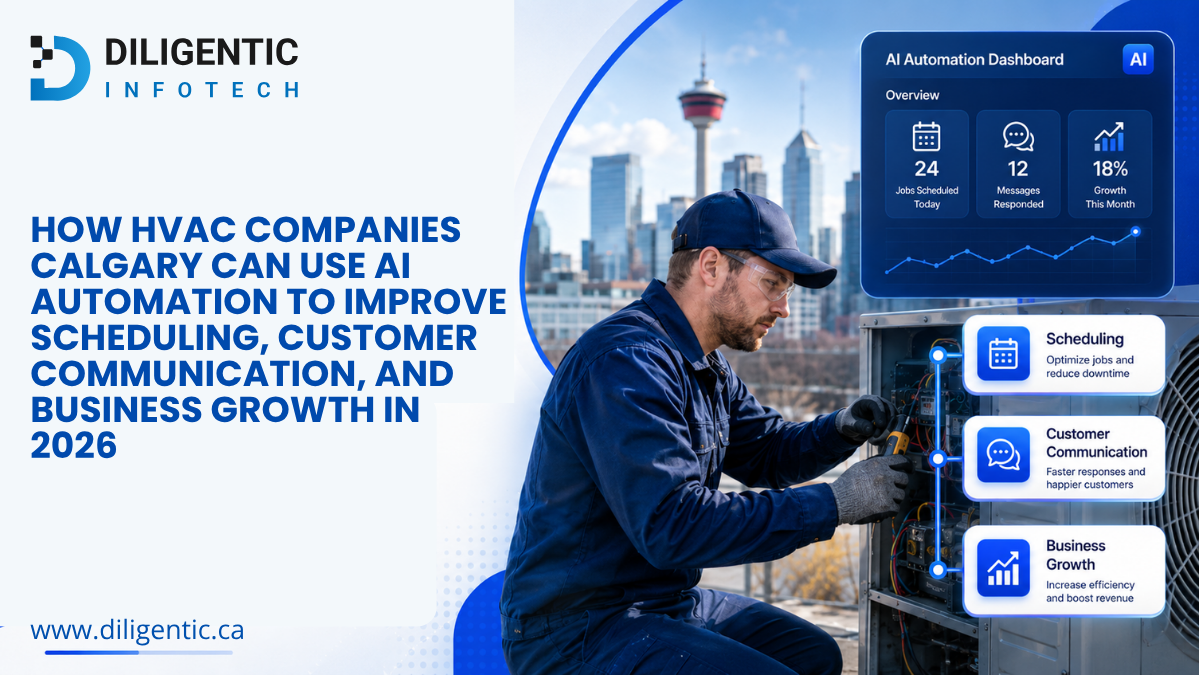
How HVAC Companies Calgary Can Use AI Automation to Improve Scheduling, Customer Communication, and Business Growth in 2026
HVAC Companies Calgary can use AI automation in 2026 to improve scheduling, reduce missed calls, send faster customer updates, organize service history, automate follow-ups, and track business performance from one connected system. The best results come when AI is built into custom HVAC software that matches the company’s real workflow, team structure, approval process, and growth goals.

Posted on 14 Jul 2026
Why Calgary HVAC Business Owners Are Stuck with Unpredictable Growth and Losing Control of Daily Jobs in 2026
Many Calgary HVAC business owners are losing control because they lack software. They are losing control because job information is spread across disconnected tools. CRM, scheduling, dispatch, invoicing, technician updates, and customer communication do not always work together. AI automation connects supported systems, reduces manual coordination, and makes daily operations more visible and predictable.